

History
A brief history of St. John’s
Introduction
Kirkheaton means in old English, ‘church of the high settlement’, and there is good archaeological evidence to suggest that the site of John the Baptist’s church has been a place of Christian worship for well over 1,000 years. So much has been written on the history of this sacred area, that if all of it were replicated on this website, the history section would be longer than all the other parts put together! A short history must therefore suffice. Most of the material for this section has been taken from a booklet written by Liz Greensides in 1988 to mark the 100th anniversary of the re-opening of the church following the fire of 1886. Other material has been taken from the leaflet, ‘Historic Churches of West Yorkshire: Kirkheaton Church’, published by the West Yorkshire Archaeology Service in 1991, and the leaflet, ‘An Appeal to Raise Funds for the Restoration and Conservation of the Beaumont Memorials’, also published by the West Yorkshire Archaeology Service. Both of these leaflets are available in St John’s church.

It should be noted, however, that, whilst the church building is precious to us, we don’t worship it: we worship the God who inhabits it and whose Spirit flows from it and around the surrounding parish. Ultimately, the church building is a tool for the worship of God, the sharing of his good news and the extension of his Kingdom. As such, it’s an important tool, but nowhere near as important as the purpose it was created for: to be a centre of worship and witness to Jesus in this parish. In that context and with that understanding, we hope you enjoy this brief history of the building.
Anglo-Saxon Period
In the late 7th century, the Christian Northumbrian king, Oswiu, established monasteries throughout his kingdom, one of which is believed to have been at Dewsbury. Dewsbury Parish was large and probably included simple, timber-and-thatch chapels in the surrounding villages of Almondbury, Bradford, Halifax, Huddersfield, Kirkburton, Mirfield, Thornhill and Kirkheaton, to where a priest or monk would be sent from the monastery to preach to the gathered villagers every sabbath. Within a century or two, a stone chapel had been built at Kirkheaton, a few small parts of which have been excavated and are now housed in Huddersfield’s Tolson Museum:

A window head from the earliest Kirkheaton stone chapel, late 9th to early 10th century.
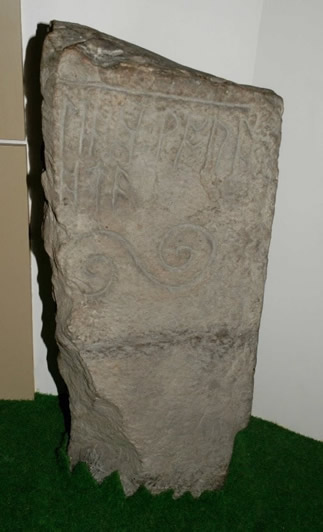
A memorial from the late 9th to early 10th century stone chapel. It bears a runic inscription which reads, ‘Eoh made this’.

A fragment of a cross shaft from the late 9th to early 10th century stone chapel.
Late Medieval Period
In the late 12th or early 13th century, Kirkheaton – comprising the four townships of Heaton, Dalton, Lepton and Upper Whitley – separated from Dewsbury to become a parish in its own right. A mother church for the new parish was required, and it was seemingly decided to build this on the current site of St John’s, as the borders of three of the townships – Lepton, Dalton and Kirkheaton – converged there. The new building comprised a chancel, nave and porch. Very little has survived, however, of the church building from this time, but one important artefact from the period is an octagonal font, still in use today.
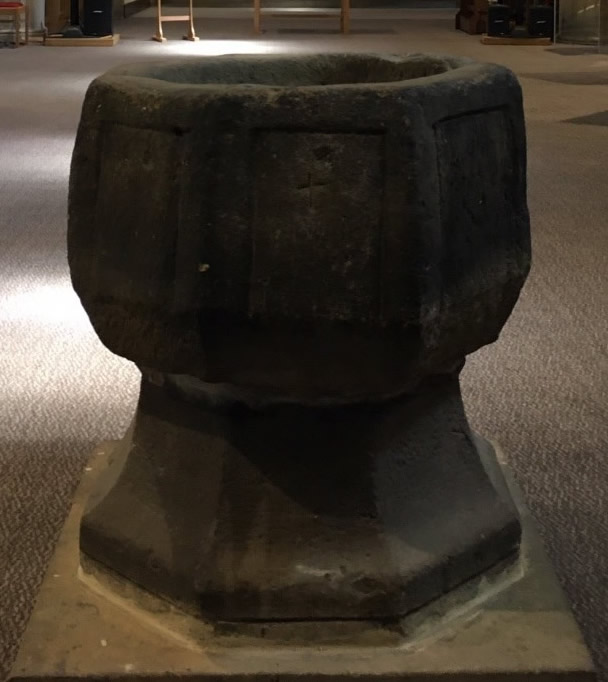
A font from the 13th century building, still the church’s main font today.
The first recorded Rector of the parish was ‘Adam the Parson of Heton’ in 1220, though the first Rector listed on the Rectors’ Board on the south interior wall of the bell tower is ‘Thomas de Kirkeby’, appointed in 1245.

The main Rectors’ Board from 1245 to 1962. When space ran out, a new smaller Rectors’ Board was made and hangs just below this one.
In the middle of the 14th century, a chantry was built to the north side of the chancel and dedicated to the Virgin Mary.

The chantry today, now known as the Beaumont Chapel.
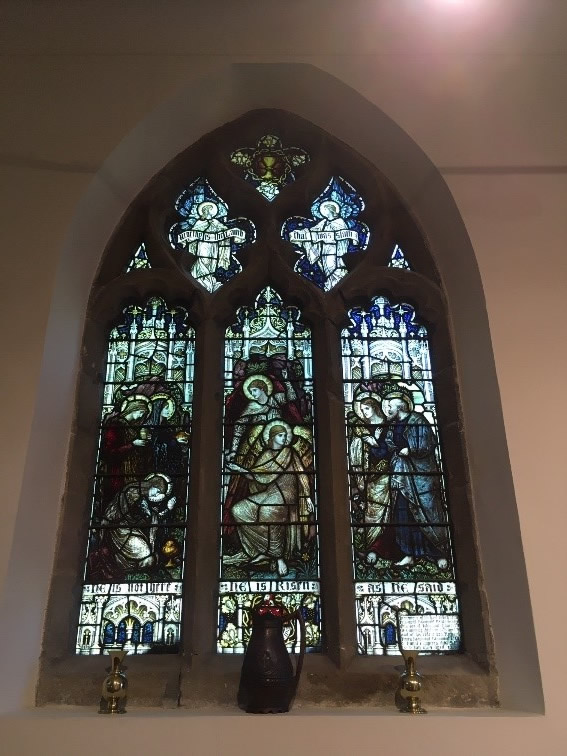
The 14th century window in the north wall of the Beaumont Chapel.
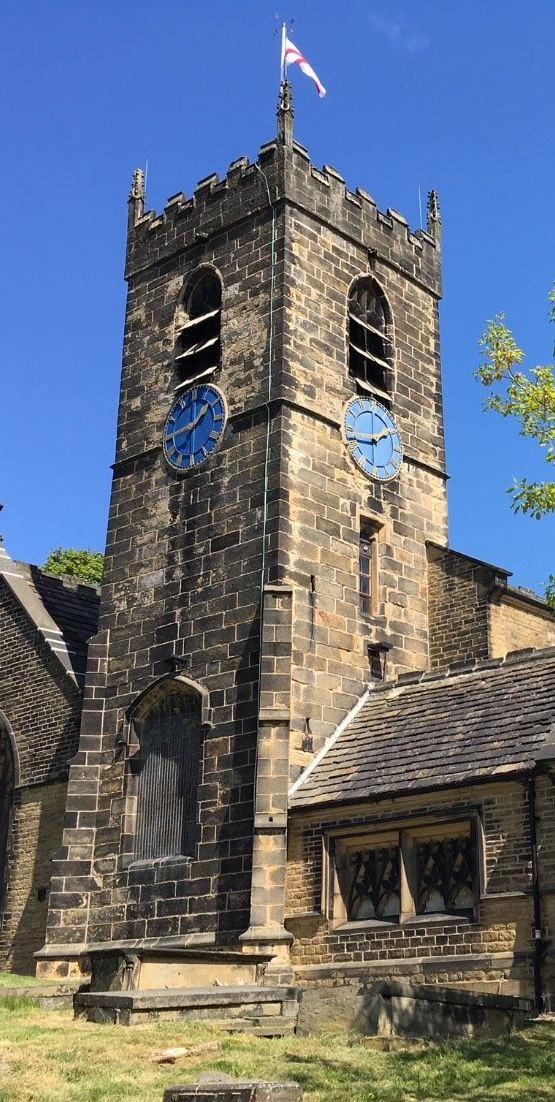
In the 15th century, the bell tower was added to the west end of the nave.
In medieval times, the church building would have been used not just for worship, but as the civic centre of the village. Thus law courts, fairs and markets would have operated outside or, in inclement weather, inside the church building. For centuries, the interior of the building would have been empty of pews or seats; pews were gradually introduced for the benefit of the rich, with the poorer congregants continuing to stand or sit on the floor!
16th – 18th Centuries
By the 16th century, the wealthy Beaumonts of Whitley Hall had for generations buried their dead under the ‘Quire of our Blessed Lady’. However, in 1574 Edward Beaumont stipulated in his will that he wished to be buried ‘in my own Quire at Kirkheaton’, thus essentially assuming ownership of the chantry, from which point it became known as the ‘Beaumont Chapel’. Edward’s son, Sir Richard Beaumont, who had been knighted in 1609 by James I, was known as ‘Black Dick of the North’, probably due to his dark hair and flamboyant moustache. When Sir Richard died in 1631, a monument in his memory was erected on the north wall of the chapel over his grave. It still stands there today.
All Church of England parishes have a Patron. A Patron is an individual or organisation that has, historically, a part in appointing a new Incumbent (i.e. a new Rector, Vicar or Parson) to a parish. The current Patron of Kirkheaton Parish is the evangelical organisation, Church Pastoral Aid Society (CPAS). The main Rectors’ Board in the church shows that on three occasions in the parish’s history, the Patron has been the then King: Henry VIII in 1511, Charles I in 1627 and Charles II in 1663.
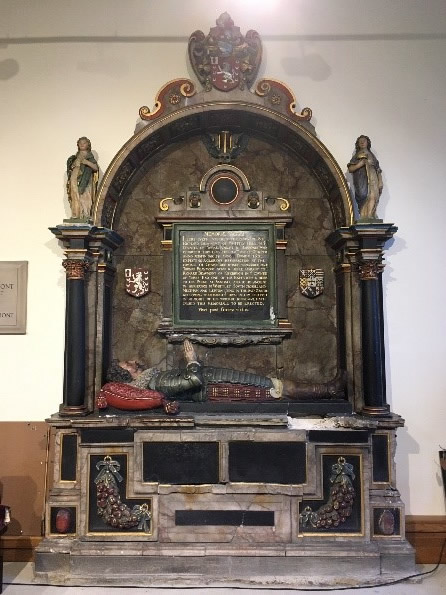
The burial monument to Sir Richard Beaumont, ‘Black Dick’.
19th Century
Notwithstanding various alterations and extensions, the 13th century chancel, nave and porch remained largely intact into the early 19th century:

St John’s in 1818, showing the nave, chancel and porch built in the 13th century, the Beaumont Chapel added in the 14th century, the bell tower added in the 15th century, and the vestry added in the late 18th century.
By the 1820s, however, the building had become neglected and rundown, and so in 1823, a major renovation was embarked upon. The south wall was demolished and rebuilt with three gothic windows. Also demolished and rebuilt were the south porch, the arcade of the north aisle and the chancel arch.
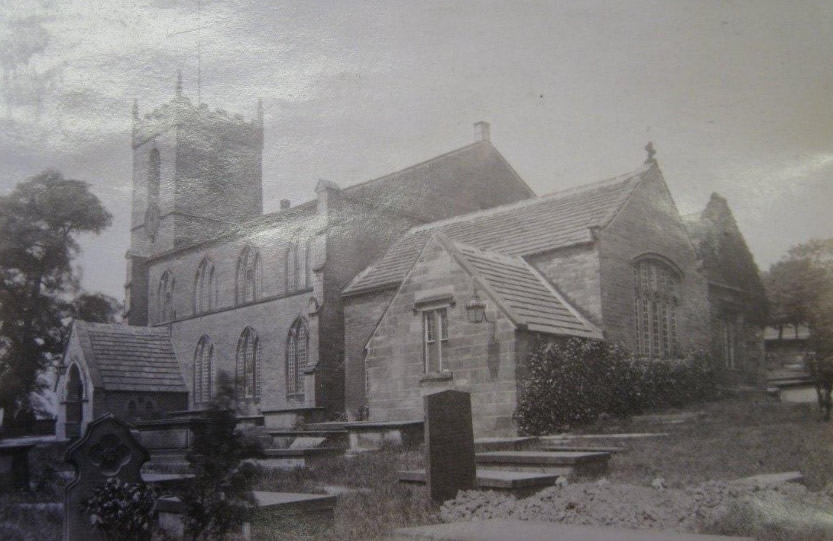
St John’s following the 1823 renovation.
The Fire of 1886
On the afternoon of Sunday 21st February 1886, most of St John’s church building was destroyed by a devastating fire caused by a defective, underfloor heating system. Only the bell tower and the Beaumont Chapel were salvageable. Rather than trying to repair the most severely damaged parts of the building – the nave, the chancel, the vestry, the south aisle and the north aisle – it was decided to demolish these and build essentially an entirely new church building between the bell tower and the Beaumont Chapel. The reconstruction took two years to complete at a cost of about £8,000. Apart from the insurance money received of £850, the cost of the reconstruction was met entirely through public subscription. The building reopened in 1888, and it is this that one sees today:
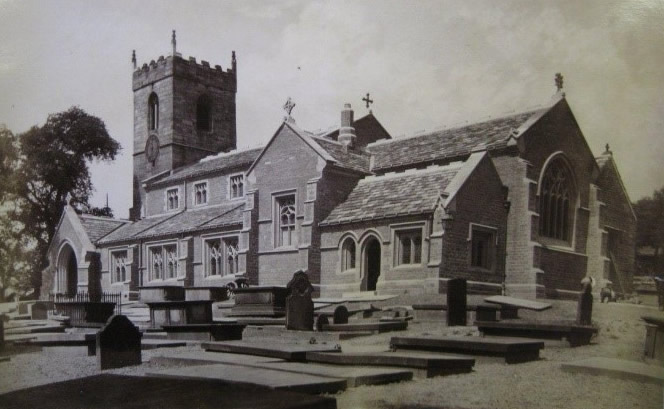
St John’s in 1888, after its reconstruction.
20th Century
The 20th century was a period of significant growth for St John’s, due to the Holy Spirit’s work through a succession of outstanding Rectors, Curates, Licensed Lay Ministers (then known as ‘Readers’), churchwardens and members of the congregation, all working together for the extension of Jesus’s Kingdom in Kirkheaton Parish.


Photographs of a special service at St John’s from the 1970s. It is possibly a photo of a carol service on 14th December 1975 or 11th December 1977, or it may be a confirmation service from that same era (note the Bishop in attendance in the last picture).
Early 21st Century
Towards the end of the first decade of this century, the then Rector, Richard Steel, together with the Parochial Church Council (PCC), discerned from God that the time had come to ‘reorder’ the church (an ecclesial term, essentially meaning to renovate and redesign the interior of the building). Prior to this, like most Anglican churches, the interior of St John’s comprised pews and choir stalls, together with a noticeably sloping floor, an inefficient heating system, only a very basic kitchenette and no toilet!

The nave and south aisle, looking westwards, c. 2010.
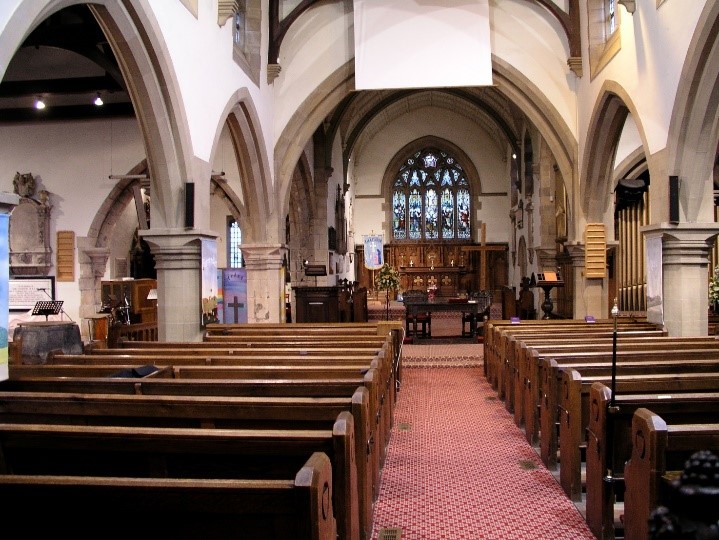
The nave and chancel, looking eastwards, c. 2010.
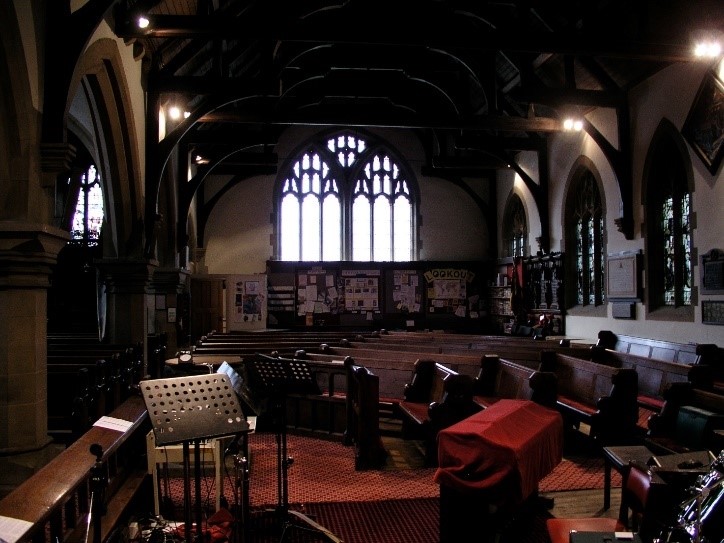
The north aisle, looking westwards towards the kitchenette, 2010 (notice how dark the north aisle then was).
Richard and the PCC had a vision to dig up and relay the floor (correcting the slope and putting in new electrical cabling and heating pipes), install a brand-new and efficient heating system as well as long-overdue toilets and a proper kitchen, replaster and repaint the whole building, lay new carpet through most of the building and a wood-laminate floor in the north aisle, install new audio-visual technology and, finally, replace the pews with chairs, so that they could be moved around to provide various seating configurations for different events. Money that the parish had acquired through the sale of the old school house land was used to fund the work, which took place between April and December 2013.
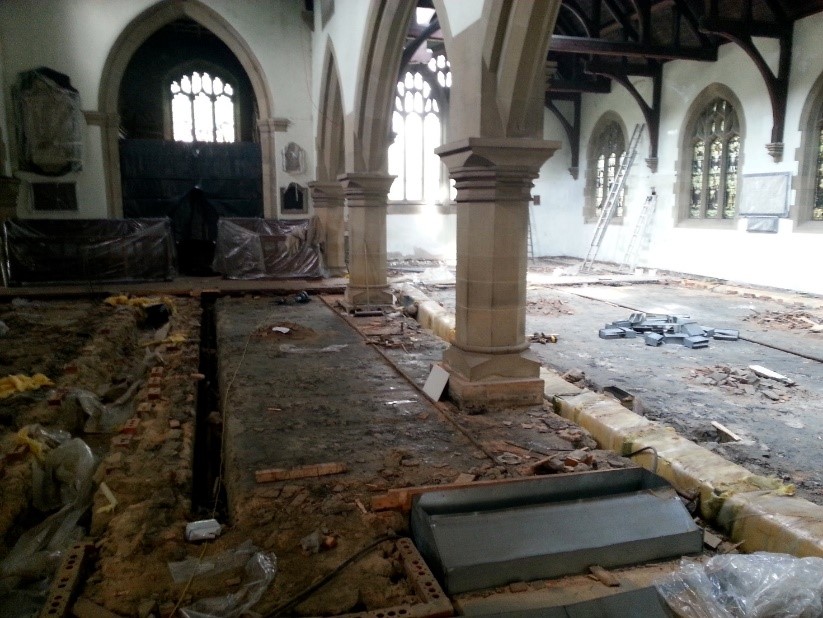


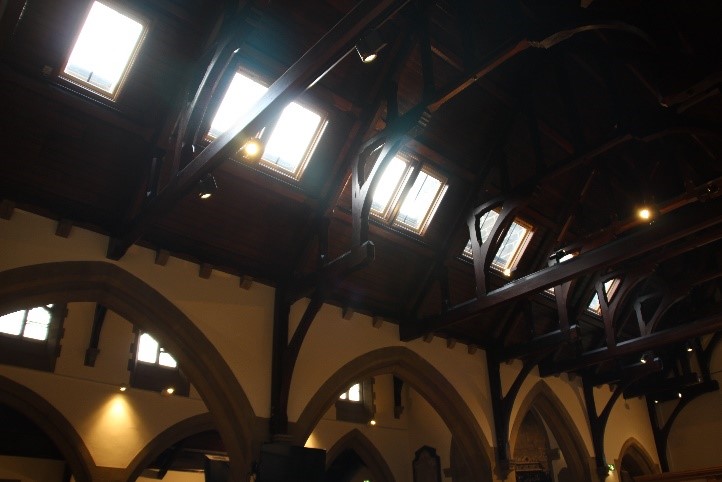


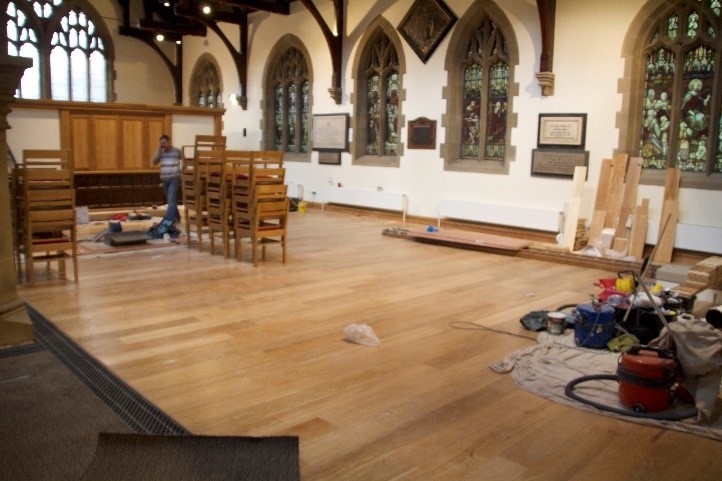

After this work was completed:
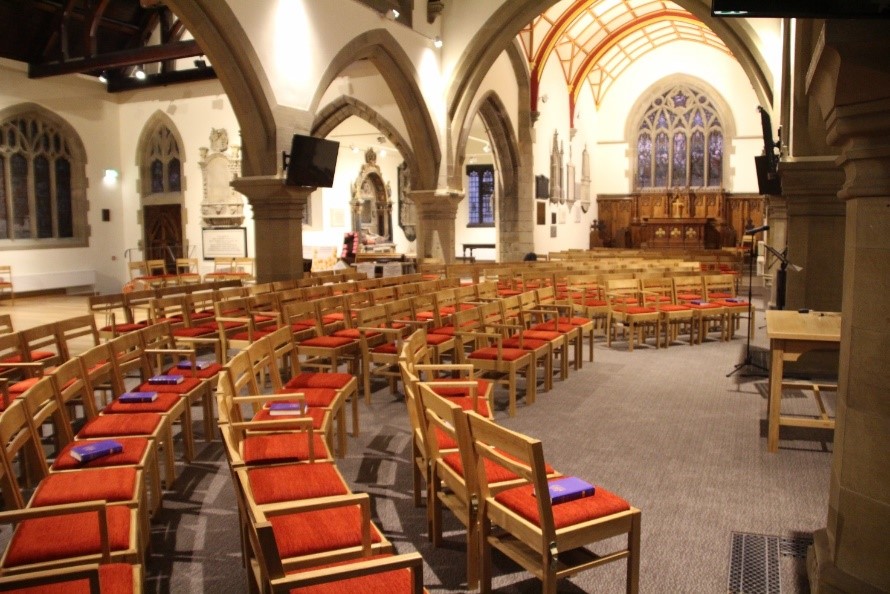
Seating can now be turned in any direction the Holy Spirit wants for a particular service.
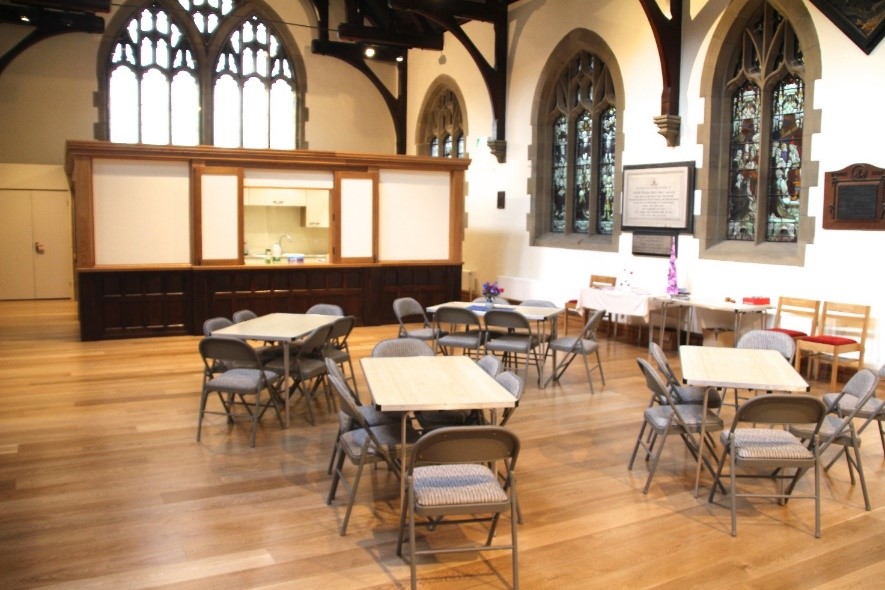
The (now well-lit) north aisle, with its proper kitchen and newly-installed toilets, can be used for post-service refreshments and social events.

Worshippers can now see song words and audio-visual aids through monitors spaced around the building.


The floor space is now completely adaptable and enables events such as the annual Arts Festival and social evenings.
2017 to Present
2017 saw the arrival of the current Rector, Ian Jones. Ian has inherited from Richard a fantastic building that beautifully combines the ancient and the contemporary: a church steeped in over 1,000 years of Christian worship and witness, and yet with almost every modern technology one could need to share the gospel. With no major building work now required for many years to come, Ian’s priority is to build on Richard’s and earlier Rectors’ work in spreading the good news of Jesus to all the people of Kirkheaton Parish, and to build up the church numerically and spiritually, especially amongst children and young people.

Revd Ian Jones with his wife, Helen, on the day of his licensing, 22nd June 2017.